
Long before Seattle became a city, the land was home to the Coast Salish peoples. Many Seattle museums begin their local history narratives by acknowledging these Indigenous communities and their deep connection to the land and waterways.
The region’s rivers, forests, and Puget Sound were central to Indigenous life, supporting fishing, trade, and cultural traditions. Museums today preserve this history through artifacts, oral storytelling, and interpretive exhibits that highlight Indigenous perspectives.
The Wing Luke Museum, in particular, integrates Indigenous context into broader immigrant narratives, helping visitors understand that Seattle’s history begins long before urban development.
Early Settlement and the Birth of Seattle
Seattle’s recorded history as a city began in the mid-19th century when European-American settlers arrived in the region. The city was named after Chief Seattle (Si’ahl), a leader of the Duwamish and Suquamish tribes.
Early settlement focused on logging, fishing, and maritime trade. Museums such as the Museum of History & Industry (MOHAI) provide detailed exhibits on this period, showcasing how small settlements grew around natural harbors and forest resources.
Artifacts such as early maps, photographs, and reconstructed settler environments help visitors visualize Seattle’s beginnings as a rugged frontier town.
The Great Seattle Fire and Urban Rebirth
One of the most defining events in Seattle’s local history is the Great Seattle Fire of 1889. This disaster destroyed much of the city’s central business district but also led to a dramatic rebuilding effort.
Museums like MOHAI document this transformation in detail, showing how Seattle was rebuilt using stronger materials and improved urban planning. Streets were raised, buildings were redesigned, and infrastructure was modernized.
This moment represents a turning point in Seattle’s identity—turning destruction into opportunity and setting the stage for rapid growth.
Maritime Economy and Waterfront Development
Seattle’s location on Puget Sound made it a natural maritime hub. Local history exhibits emphasize how shipping, fishing, and trade shaped the city’s economy.
At MOHAI, visitors can explore exhibits on shipbuilding, port development, and international trade routes connecting Seattle to Alaska and Asia. The waterfront played a central role in employment and commerce, influencing the city’s growth for decades.
Today, remnants of this maritime history remain visible along Seattle’s piers and docks, linking museum narratives to real-world geography.
Industrial Expansion and the Boeing Era
The 20th century brought industrial transformation, particularly with the rise of aviation. Boeing became one of Seattle’s most influential companies, shaping both the economy and urban development.
Local history museums highlight how aircraft production during World War II and the post-war era turned Seattle into a major industrial center. This period also brought population growth and suburban expansion.
Exhibits often include aircraft models, factory photographs, and personal stories from workers who contributed to Seattle’s industrial boom.
Immigration and Cultural Diversity in Local History
Seattle’s local history is deeply tied to immigration. Communities from Asia, Europe, Latin America, and Africa have all contributed to the city’s cultural fabric.
The Wing Luke Museum of the Asian Pacific American Experience is especially important for documenting these stories. It highlights Chinese railroad workers, Japanese American families affected by wartime incarceration, Filipino labor communities, and broader Asian Pacific American experiences.
Rather than presenting immigration as a single narrative, the museum emphasizes multiple voices and lived experiences, showing how diverse communities shaped Seattle’s neighborhoods, businesses, and identity.
Neighborhood Development and Urban Growth
Seattle’s local history is also told through its neighborhoods. Areas like Capitol Hill, Pioneer Square, and the International District each reflect different phases of development.
Museums and cultural institutions often include neighborhood-focused exhibits that explain how zoning, migration, and economic shifts shaped urban growth.
For example:
- Pioneer Square reflects early rebuilding after the fire
- Capitol Hill shows cultural and artistic evolution
- South Lake Union represents modern tech expansion
These localized histories help visitors understand Seattle as a mosaic of distinct communities.
The Rise of Technology and Modern Identity
While museums focus heavily on historical roots, they also connect local history to Seattle’s modern identity as a technology hub.
MOHAI, in particular, explores how companies like Microsoft and Amazon emerged from the region’s innovative culture. These developments are framed as extensions of earlier industrial and aviation growth.
This continuity helps visitors understand that Seattle’s tech success is not accidental—it is built on decades of innovation, infrastructure, and entrepreneurship.
Art Museums as Historical Narratives
Even art museums contribute to Seattle’s local history storytelling. The Seattle Art Museum (SAM) preserves cultural artifacts from around the world, but also reflects Seattle’s evolving identity through contemporary exhibitions.
Art often serves as a historical record, capturing social change, migration patterns, and cultural dialogue. SAM’s collections help contextualize Seattle’s place within global history while still connecting back to local development.
Similarly, the Seattle Asian Art Museum provides historical continuity by showcasing ancient Asian art alongside modern interpretations, linking Seattle’s immigrant communities to broader cultural traditions.
Preservation of Historical Landmarks
Seattle museums also extend beyond indoor exhibits by preserving historical landmarks and integrating them into educational experiences.
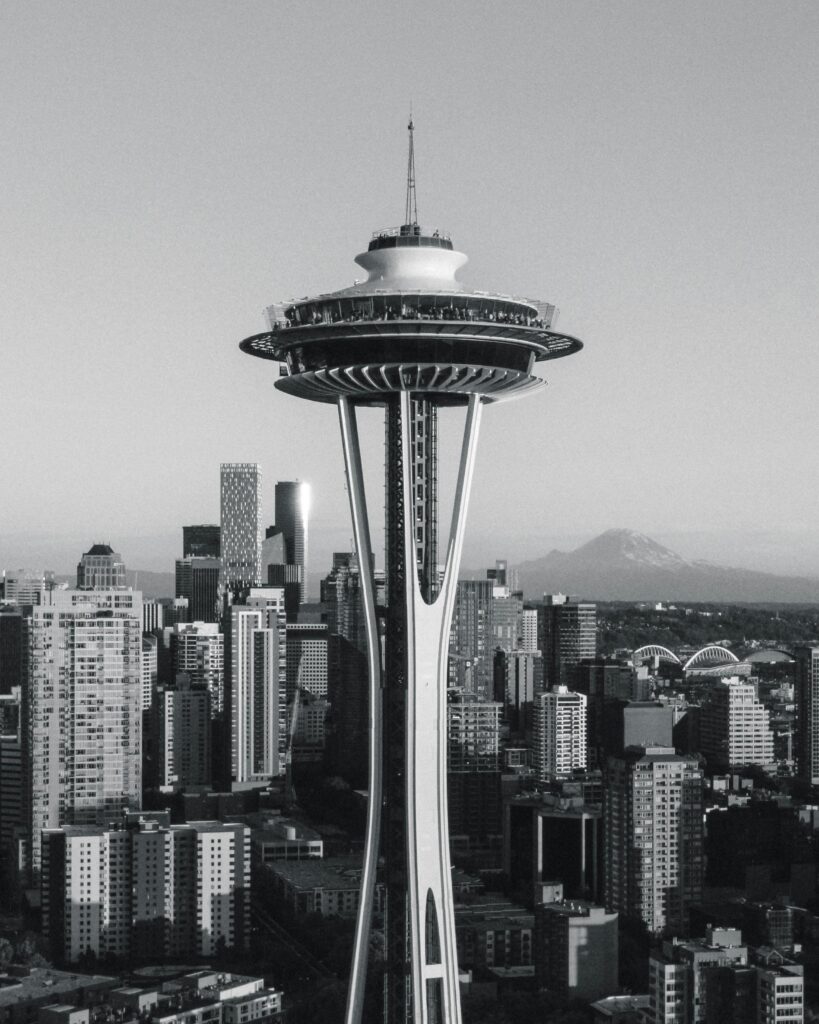
The Space Needle, though not a museum, is often included in local history tours because it represents the optimism and modernization of the 1962 World’s Fair era.
Nearby cultural districts allow visitors to connect museum narratives with physical locations, reinforcing the relationship between history and geography.
Interactive Storytelling in Local History Exhibits
Modern Seattle museums increasingly use interactive technology to present local history in engaging ways.
At MOHAI and Wing Luke Museum, visitors encounter:
- Digital timelines of city development
- Oral history recordings from residents
- Interactive city maps showing urban growth
- Recreated historical environments
- Multimedia storytelling installations
These tools help transform static history into immersive experiences, making local history more accessible to younger audiences.
Seattle’s Local History Through Community Voices
A key strength of Seattle museum storytelling is its focus on community voices. Instead of presenting history as a top-down narrative, museums emphasize personal stories from residents.
This includes:
- Immigrant family histories
- Indigenous oral traditions
- Worker experiences in maritime and aviation industries
- Neighborhood-based storytelling projects
This approach ensures that Seattle’s local history is diverse, inclusive, and deeply human.
Connecting Museums with Real City Exploration
One of the most powerful aspects of Seattle’s local history museums is how easily they connect with the city itself. Visitors can walk through neighborhoods that reflect the stories they just learned inside museums.
For example:
- After visiting MOHAI, visitors can walk along Lake Union’s waterfront
- After Wing Luke Museum, they can explore the International District
- After downtown museums, they can experience historic Pioneer Square
This seamless integration makes Seattle a living museum city.
Seattle museum local history offers a rich, multi-layered understanding of how a small coastal settlement became a global cultural and technological powerhouse. Through institutions like MOHAI, Wing Luke Museum, Seattle Art Museum, and Seattle Asian Art Museum, visitors gain insight into Indigenous heritage, industrial expansion, immigration, and modern innovation.
What makes Seattle unique is not just the events of its past, but how those events are preserved and interpreted. Museums transform local history into an interactive, emotional, and educational journey.
Ultimately, exploring Seattle through its museums allows visitors to see the city not just as a destination, but as a living story—one shaped by generations of people, cultures, and ideas that continue to define its identity today.
Leave a Reply